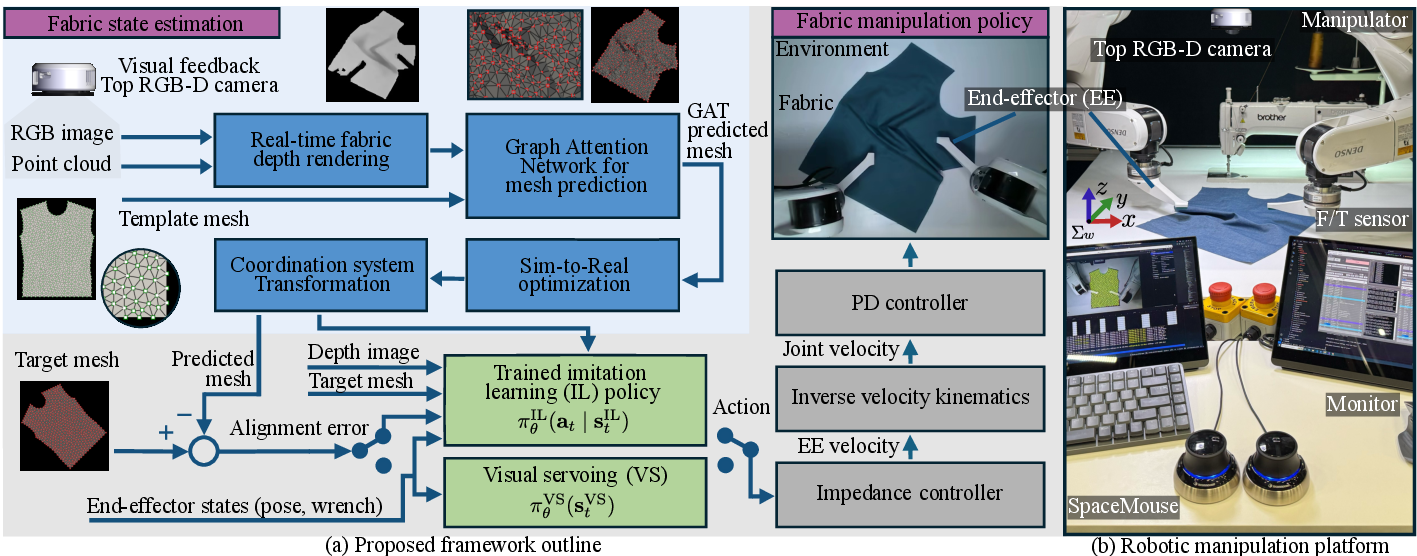
- State estimation. RGB-D → segmented depth → GAT mesh prediction → sim-to-real refinement, yielding a wrinkle-aware predicted mesh even under end-effector occlusion.
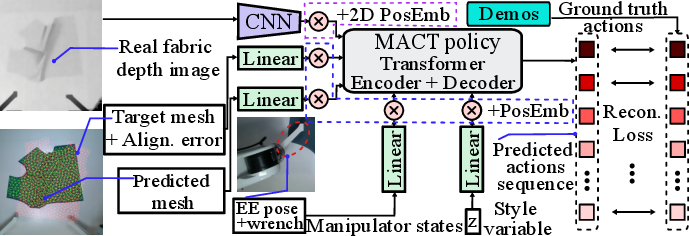
- IL (MACT) for coarse alignment. A mesh-conditioned Action Chunking Transformer flattens wrinkles and roughly aligns the fabric to the target from a compact set of teleoperation demos.
- VS for fine alignment. Once the fabric is flat, near the target, and dual-grasped, position-based visual servoing drives precise convergence to the target pose.
RTFF: Random-to-Target Fabric Flattening Policy using Dual-Arm Manipulator
Abstract
Robotic fabric manipulation remains challenging due to fabric deformability and occlusions from wrinkles and the manipulator. This paper defines Random-to-Target Fabric Flattening (RTFF) as the task of bringing a randomly wrinkled fabric to an arbitrary user-specified wrinkle-free target pose. RTFF requires simultaneous flattening and pose alignment, where the two objectives are inherently coupled since flattening the fabric displaces its pose, while realigning it tends to introduce wrinkles. To solve this task, this paper anchors both the current and target fabric states to the same template mesh, enabling direct vertex-level wrinkle and pose assessment without registration. Building on this representation, a hybrid Imitation Learning--Visual Servoing (IL--VS) RTFF policy is proposed. A novel Mesh Action Chunking Transformer (MACT) leverages structured mesh observations to achieve goal-conditioned coarse alignment from a compact demonstration set, after which VS ensures precise convergence to the target. The policy is validated on a real dual-arm teleoperation system, demonstrating precise alignment to unseen target poses, fabric types, and scales.
Supplemental Video
Method
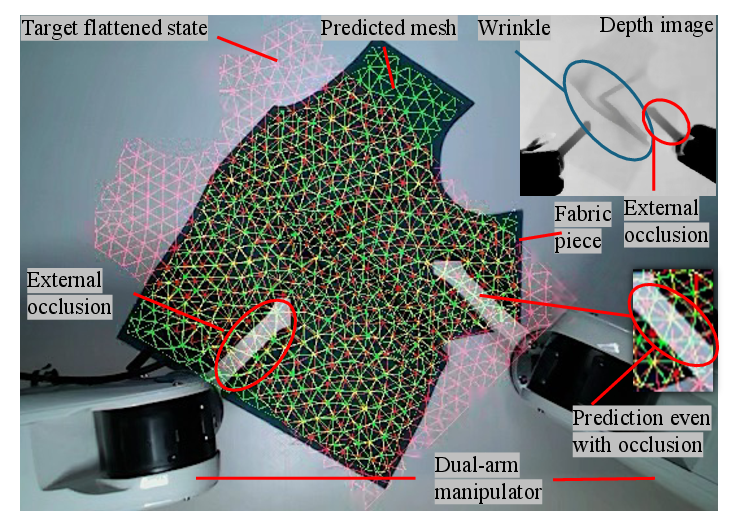
RTFF brings a randomly wrinkled fabric to a user-specified wrinkle-free target pose. Both the current state and the target are anchored to the same CAD-derived template mesh, so wrinkle severity and pose error can be read directly at corresponding vertices—without registration.
Task Setup
Overall Pipeline
MACT Architecture
Results
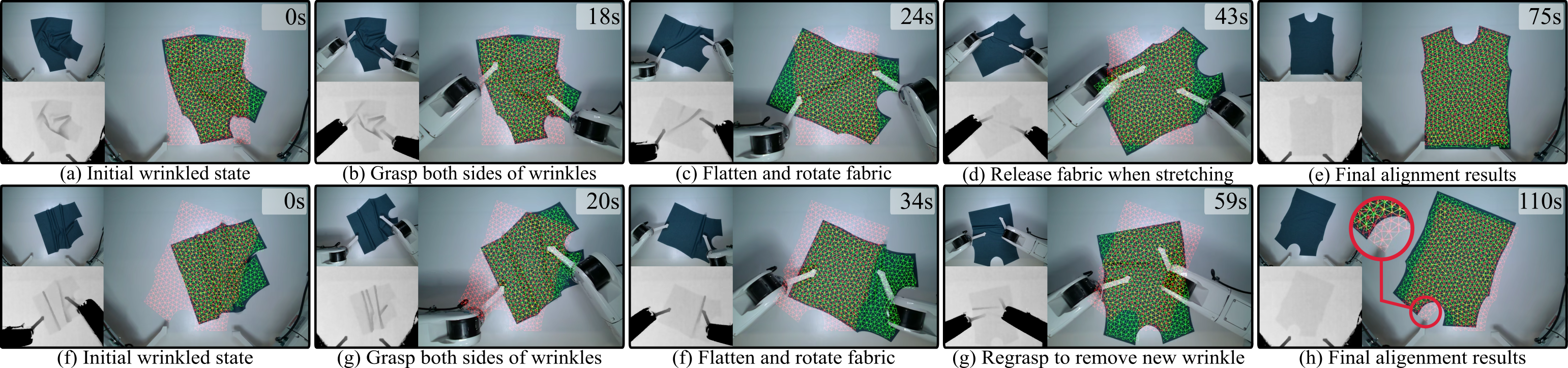
Evaluated on a real dual-arm teleoperation system across 20 initial/target pairs. The full RTFF policy converges reliably; mesh conditioning and VS are both essential.
Key Metrics
0.011 m
Terminal alignment error
0.926
Mean IoU
0 / 20
Failures
Execution Sequences
Ablation Study
Without VS, error rises and variance grows. Without predicted mesh and alignment error—even when segmented depth is added—the policy fails to reach the target.
| Method | Error (m) | IoU | Fail. |
|---|---|---|---|
| Ours | 0.011 ± 0.002 | 0.926 ± 0.018 | — |
| w/o VS | 0.028 ± 0.010 | 0.871 ± 0.050 | — |
| w/o mesh & error | — | — | 5/5 |
| w seg. depth, w/o mesh & error | — | — | 5/5 |
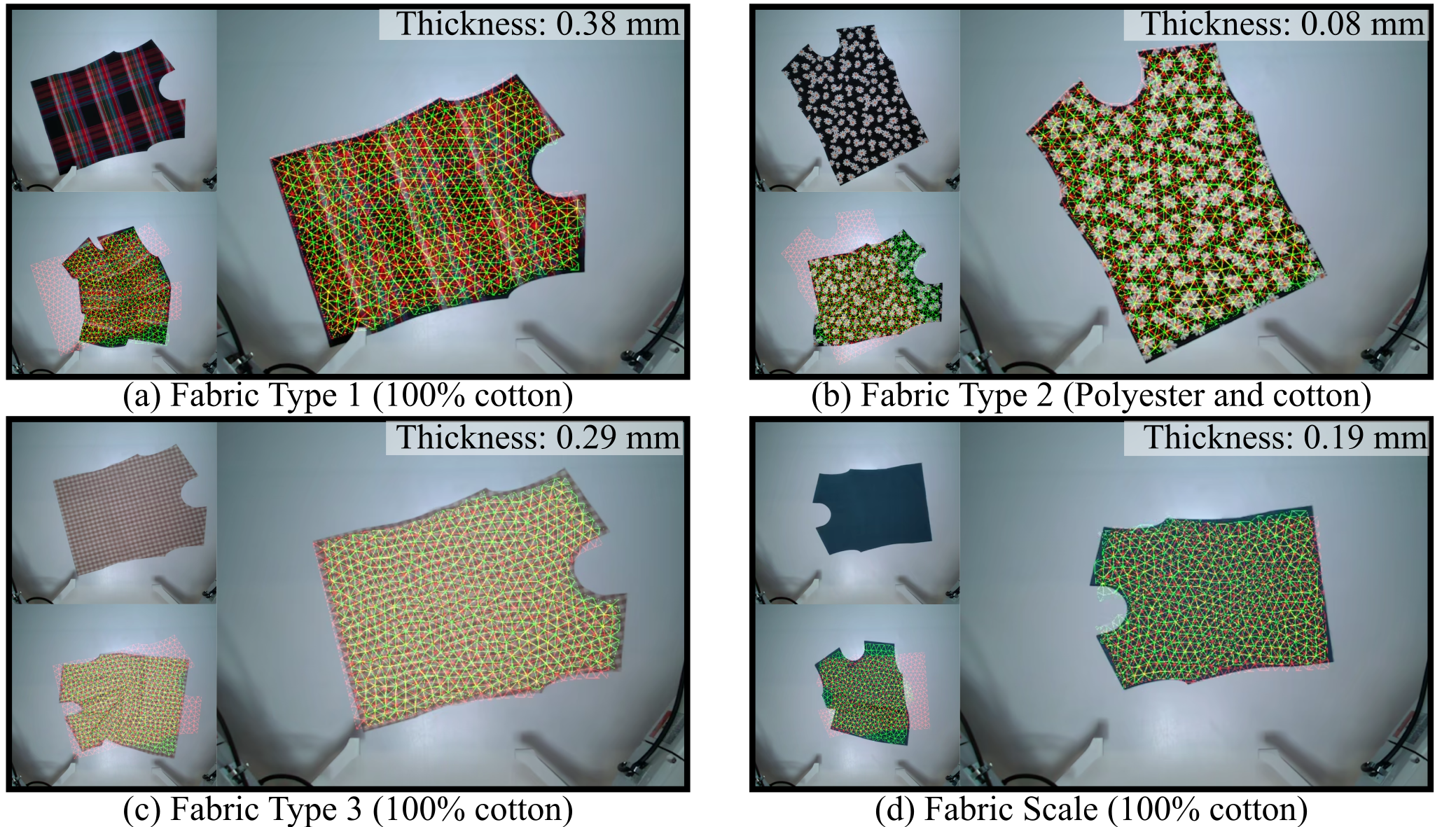
| Unseen fabric type | 0.0145 ± 0.004 | 0.911 ± 0.031 | — |
| Unseen scale (80%) | 0.021 ± 0.004 | 0.893 ± 0.022 | — |
Generalization
Trained on one fabric, the same policy generalizes to unseen materials and an 80% scale without retraining.
BibTeX
@misc{tang2026rtffrandomtotargetfabricflattening,
        title={RTFF: Random-to-Target Fabric Flattening Policy using Dual-Arm Manipulator},
        author={Kai Tang and Dipankar Bhattacharya and Hang Xu and Fuyuki Tokuda and Norman C. Tien and Kazuhiro Kosuge},
        year={2026},
        eprint={2510.00814},
        archivePrefix={arXiv},
        primaryClass={cs.RO},
        url={https://arxiv.org/abs/2510.00814},
}